Posted By: Southern Fabricating Machinery Sales | Posted On: September 21, 2026
For many machine shops, adding another piece of CNC equipment is a major investment decision. The machine has to do more than simply add another process—it needs to create new opportunities, solve manufacturing problems and provide capabilities that existing equipment cannot easily duplicate.
That is where Wire EDM can become a valuable addition to a modern manufacturing operation.
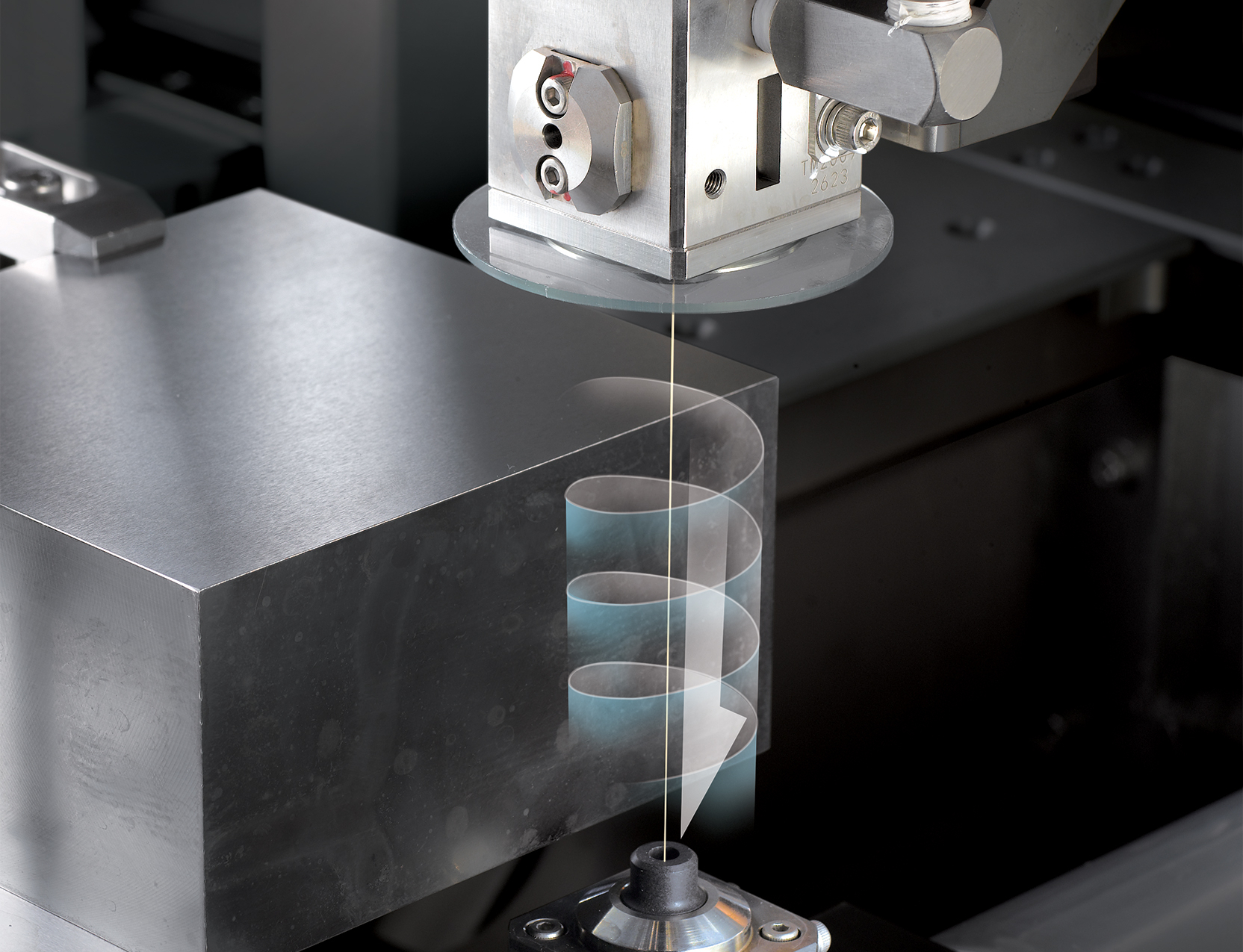
Wire Electrical Discharge Machining, commonly called Wire EDM or WEDM, uses a continuously traveling electrically conductive wire and controlled electrical discharges to remove material. Because the wire never physically contacts the workpiece, the process produces virtually no conventional cutting forces. This makes Wire EDM particularly valuable for hardened tool steels, intricate profiles, thin sections, tight internal radii and components where conventional milling or grinding becomes difficult.

For a shop that currently offers CNC milling, turning, laser cutting, waterjet or conventional machining, Wire EDM can fill an important gap in the manufacturing process.
Understanding WIRE EDM - The Basics
At its simplest, a Wire EDM machine cuts metal with controlled electrical sparks rather than a conventional cutting tool.
A very fine wire—commonly brass or a coated wire—is continuously fed through the machine. The workpiece and wire are separated by a precisely controlled gap. Electrical pulses create sparks across that gap, and those discharges remove extremely small amounts of material from the workpiece.
The wire does not actually touch the material.
Most modern Wire EDM machines use filtered, deionized water as the dielectric fluid. The workpiece is either partially or completely submerged while high-pressure flushing removes eroded particles from the cutting area. Automatic wire threading allows the machine to re-thread itself after a wire break and also enables long periods of unattended operation.
Typical wire diameters are approximately 0.004" to 0.012", with 0.010" being a common production size. Smaller wire can produce tighter internal radii, while larger wire can support higher cutting energy and faster roughing.
What Can a Wire EDM Do?
The real value of Wire EDM becomes apparent when you look at the types of components it can produce.
Wire EDM is particularly useful for:
- Punches and dies
- Tool-and-die components
- Carbide components
- Hardened tool steel
- Precision gears and splines
- Fine slots
- Complex internal profiles
- Medical components
- Aerospace components
- Electrical and connector components
- Prototype components
- Small-batch production
- Precision inserts
- Mold components
- Thin webs and delicate profiles


One of Wire EDM's biggest advantages is that material hardness is not the same limitation it is with conventional machining. Conductivity is the key requirement. Hardened tool steel that would be difficult or expensive to mill can often be Wire EDM'd efficiently because the wire is not mechanically cutting the material.
Accuracy Without Cutting Forces
Imagine machining a very thin section of hardened steel with a conventional milling cutter. Cutting forces can cause vibration, deflection or distortion.
Wire EDM approaches the problem differently.
Because there is no physical contact between the electrode and workpiece, there is essentially no conventional cutting pressure. This makes the process particularly useful for delicate geometries and components where maintaining dimensional integrity is critical.
Modern Wire EDM machines can achieve extremely high accuracy, particularly when multiple skim cuts are used. Actual performance depends on the machine, material, thickness, thermal stability, programming and cutting conditions, but high-end equipment can operate in the micron-level accuracy range.
The Economics of Adding Wire EDM
The question for a shop shouldn't simply be:
"How much does a Wire EDM cost?"
A better question is:
"How much work are we currently turning away because we don't have Wire EDM?"
A shop may already have customers asking for:
"Can you cut this after heat treatment?"
"Can you hold this tolerance?"
"Can you cut this internal profile?"
"Can you make this punch and die?"
"Can you cut carbide?"
"Can you produce several hundred of these precision inserts?"
Without Wire EDM capability, those jobs may be subcontracted—or lost entirely.
Adding the machine can therefore create revenue opportunities that don't necessarily compete with the shop's existing CNC equipment. Instead, it can allow the shop to keep more operations in-house.
Choosing The Right Wire EDM
Not every Wire EDM is designed for the same work.
Choosing the machine should begin with the parts you intend to manufacture, rather than simply looking at machine price.
A shop producing small punches and precision inserts has different requirements from a moldmaker cutting large components or a production manufacturer cutting hundreds of identical profiles.
Start With Workpiece Size
The first consideration is the maximum size and weight of the parts you expect to process.
Look at:
- X-axis travel
- Y-axis travel
- Z-axis capacity
- Maximum workpiece dimensions
- Maximum workpiece weight
- Tank dimensions
- Table configuration
- Maximum cutting height
Wire EDM machines are available in a wide range of capacities. One commonly encountered machine class has approximately 14" × 10" X/Y travel and an 8–10" Z capacity, but larger machines are available for substantially bigger workpieces.
Don't buy a machine that is sized only for today's largest part. Consider the work you want to win over the next five to ten years.
Automatic Wire Threading
Automatic wire threading is another important consideration.
If your shop expects to run unattended or overnight, AWT can be extremely valuable. Modern systems can automatically re-thread the wire following a break and can support extended unattended machining.
For a production-oriented shop, this can have a significant impact on machine utilization.
Taper Cutting
Do you manufacture components with angled or tapered surfaces?
If so, pay close attention to the machine's U/V axis capability and maximum taper angle.
Modern Wire EDM machines commonly use additional U/V motion to tilt the wire relative to the workpiece. This allows the machine to produce tapered profiles and different upper and lower contours.
This can be particularly important for:
- Extrusion dies
- Punches and dies
- Mold components
- Tapered inserts
- Complex tooling
- Aerospace components

Generator Technology
The EDM generator, or power source, is another area where machines can differ substantially.
The generator controls the electrical discharge used to remove material. Newer digital generator technology can provide sophisticated control of discharge conditions, helping optimize cutting speed, surface finish, recast and wire consumption.
When comparing used machines, don't evaluate only the mechanical condition. The control and generator technology can be just as important. A machine that looks inexpensive may require considerably more time and consumables to produce the same result as a newer-generation machine.
Wire Consumption and Operating Costs
Wire is a consumable, and wire consumption is an important operating expense.
Modern machines have become more efficient at managing wire consumption. Some systems can consume approximately 0.5–0.6 lb. of 0.010" wire per hour under particular operating conditions, although actual consumption varies substantially with cutting parameters and application. (SST Consumables)
When evaluating a Wire EDM, consider the complete operating cost:
Wire + filters + resin + dielectric maintenance + power + labor + maintenance + machine depreciation
The machine with the lowest purchase price isn't necessarily the machine with the lowest cost per part.
Tooling Your Wire EDM for Precision and Accuracy
Buying the machine is only part of the equation. Proper tooling, fixturing and setup are essential to getting the performance you paid for. Because Wire EDM can produce very tight tolerances, errors in setup can become the limiting factor long before the machine reaches its capability.
Fixturing
The workpiece needs to be securely supported and accurately positioned.
Common Wire EDM tooling includes:
- Precision vises
- Subplates
- Angle fixtures
- Clamping systems
- Sine fixtures
- Rotary tables
- Custom fixtures
- Wire EDM workholding systems
The fixture needs to provide rigidity without interfering with wire travel or flushing.
For heavier workpieces, specialized vises can also simplify leveling and alignment. Operators commonly verify workpiece alignment and flatness with precision indicators before establishing the machine origin.
Wire Guides
The upper and lower wire guides are critical components. The wire must travel accurately through the workpiece while maintaining the proper tension and position. Wear, contamination or damage to guides can affect accuracy and cutting performance.
Wire Selection
Different applications can benefit from different wire types and diameters. Standard brass wire is widely used, while coated wires can provide advantages in particular applications such as speed and bewtter flushing.
Wire diameter also matters. A smaller diameter can produce smaller internal radii, while a larger wire can permit greater discharge energy, thus faster cutting during roughing operations.
Multiple Passes
One of the keys to precision Wire EDM is understanding the difference between rough cutting and skim cutting.
The first pass removes the majority of the material. Subsequent passes use progressively different cutting conditions to improve dimensional accuracy and surface finish.
As a general illustration, published industry guidance indicates that a rough pass might produce approximately ±0.001" accuracy, while additional skim passes can improve both tolerance and surface finish significantly. Actual results depend on the machine, material, geometry and process parameters.
That means when someone says:
"This Wire EDM can hold ±0.0002"."
the important follow-up question is:
"Under what conditions?"
-
Is that tolerance achievable on a rough cut?
- A two-pass operation?
- A four-pass operation?
- What material?
- What thickness?
- At what temperature?
Understanding those details is essential when comparing machines.
Finding the right machine at the right price
This is where the experience of a knowledgeable machinery dealer can make a significant difference.
There are excellent new and used Wire EDM machines available from manufacturers such as Mitsubishi, Sodick, FANUC, Makino and others. But selecting the right machine isn't simply a matter of finding the newest machine you can afford.
The right machine depends on your:
- Part size
- Material
- Material hardness
- Required tolerance
- Surface-finish requirements
- Production volume
- Taper requirements
- Automation requirements
- Wire diameter
- Machine utilization
- Available floor space
- Budget
- Service requirements
And when buying used, there are additional questions.
-
How much has the machine actually been used?
-
How well has the dielectric system been maintained?
-
Are the wire guides in good condition?
-
Does the automatic wire threading system work properly?
-
Is the generator performing correctly?
-
Are the scales and positioning systems accurate?
-
Is replacement support available for the control and critical components?
A used Wire EDM can represent an excellent opportunity—but only when the machine is properly evaluated.
Don't Buy a Machine. Buy a Capability.
The goal shouldn't be to find the cheapest Wire EDM. The goal should be to find the right Wire EDM for the work you intend to produce. A machine that costs more but allows you to win significantly more profitable work may be a better investment than an inexpensive machine that limits your applications.
Likewise, an older premium machine that has been properly maintained may make more sense for a particular application than a newer entry-level machine. That is where an experienced machinery professional can help.
Southern Fabricating Machinery Sales works with manufacturers to identify the right machinery for their application, production requirements and budget. Whether you're considering a new Wire EDM, evaluating a used machine or trying to determine whether Wire EDM makes economic sense for your operation, the first step should be understanding exactly what you need the machine to accomplish.
Southern Fabricating Machinery Sales
The experts at Southern Fab can help you evaluate machine specifications, application requirements, new versus used equipment and the overall economics of adding Wire EDM to your shop.
Because the best machinery purchase isn't necessarily the machine with the biggest specifications or the lowest price.
It's the machine that makes you more capable, more competitive and more profitable.
The Bottom Line
Wire EDM isn't intended to replace every machining process in your shop. Its value comes from doing things other processes struggle to do economically and accurately. When you need to cut hardened conductive materials, intricate internal profiles, delicate geometries, tight tolerances or complex tooling, Wire EDM can be an extremely powerful addition to your manufacturing capabilities.
And when the right Wire EDM is combined with the right tooling, programming and process knowledge, it can transform a machine shop from simply machining parts to taking on an entirely new class of precision manufacturing work.
Before you buy your next Wire EDM, talk to the machinery experts at Southern Fabricating Machinery Sales. The right machine isn't just an equipment purchase—it's an investment in what your shop can manufacture next.