
Posted By: Andy Kamashian | Posted On: November 13, 2026
In modern metal fabrication, the cut is only half the battle. Whether your parts come off a fiber laser, a plasma table, a turret punch, or a shearing machine, they rarely arrive ready for final assembly or coating. Sharp burrs, slag, laser oxide, and rough edges can compromise part fitment, ruin paint adhesion, and create serious safety hazards for your operators.
Investing in dedicated metal surface finishing machinery transforms a slow, inconsistent manual grinding bottleneck into a fast, repeatable, and profitable automated process. However, choosing the right machine requires a clear understanding of what these systems can do, the features that drive performance, and the operational limitations you must respect.
Types Of Metal Surface Finishing Machines
Metal surface finishing equipment spans a wide spectrum of designs, each engineered for specific part geometries, throughput volumes, and finish requirements. Understanding the core machine architectures is the first step in matching equipment to your shop floor.
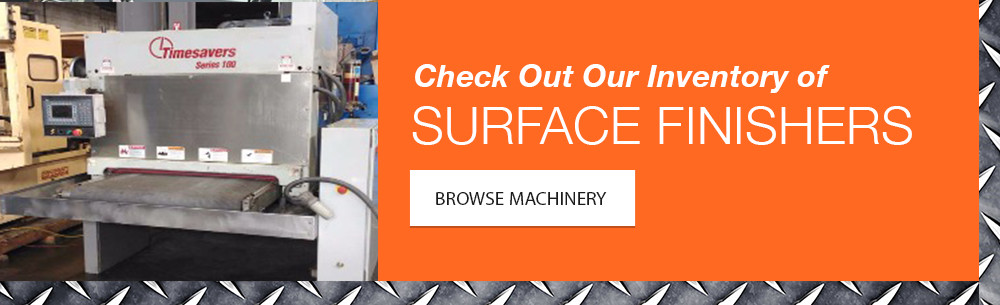
- Wide-Belt Sanders (Timesavers / Burr Kings / Lissmac style): These are the workhorses of flat sheet metal processing. Parts travel on a motorized conveyor belt beneath overhead abrasive belts or rotary brushes. They excel at removing vertical burrs, applying a uniform linear grain, and conditioning flat laser-cut or punched blanks at high speeds.
- Rotary Brush and Disc Machines: Instead of a single-direction abrasive belt, these machines utilize oscillating or planetary rotating discs and brushes. Because the abrasive media attacks the part from multiple angles simultaneously, rotary machines are the gold standard for uniform edge rounding—often achieving a true 2mm radius required for heavy-duty powder coating and aerospace compliance—without altering the flat surface dimensions.
- Vibratory Tumblers and Mass Finishing Systems: Ideal for high volumes of small, complex, or three-dimensional parts that cannot lay flat on a conveyor belt. Parts are placed into a vibrating tub or bowl filled with ceramic, plastic, or steel media and liquid compounds. Over a set cycle time, the scrubbing action deburrs intricate internal holes, polishes surfaces, and relieves surface stress.
- Manual Stroke Sanders and Backstand Grinders: While automated through-feed machines dominate high-production shops, manual stroke sanders and belt grinders remain essential for oversized weldments, box-shaped fabrications, and custom one-off prototypes that simply will not fit through a standard conveyor throat.
Wet or Dry? The Argument for Both
One of the most critical decisions when specifying a surface finishing machine is choosing between a wet system and a dry system. Both approaches have distinct mechanical advantages and operational trade-offs.
The Case for Dry Machines
Dry finishing machines are the most common choice for general carbon steel and stainless steel fabrication. They pair with an external dry dust collector (baghouse or cartridge filter) to evacuate airborne metal dust. Dry machines require less daily maintenance because there is no coolant to monitor, filter, or dispose of. Parts exit the machine completely dry and ready for immediate welding, bending, or powder coating. Furthermore, dry machines generally have a lower initial purchase price and a smaller overall footprint.
The Case for Wet Machines
Wet finishing machines flood the work zone with a continuous cascade of water-based coolant, trapping metal dust in liquid before filtering it through a paper bed or magnetic separator. The primary advantage of a wet system is thermal control. Secondary benefits are that the belt usually lasts longer as well. Coolant prevents thin-gauge parts from warping due to friction heat and stops stainless steel from discoloring. More importantly, wet systems are mandatory when processing combustible metals—more on that critical safety rule below. The trade-off is higher maintenance, higher upfront cost, and the need for an air knife or drying station if parts must be dry downstream.
Multiple Heads - Why you may need more than one sanding head for your application
When buyers look at wide-belt finishing machines, they often ask why a machine needs two, three, or even four stations instead of just one. The answer comes down to physics and abrasive efficiency: a single abrasive cannot aggressively knock down heavy slag and simultaneously leave a fine, cosmetic grain.
In a single-head machine, you are forced to compromise. If you run a coarse 60-grit belt to remove heavy plasma dross, you leave deep scratches on the part surface. If you switch to a fine 180-grit belt for a smooth finish, the abrasive will quickly glaze over and burn out trying to chew through heavy burrs.
Multi-head machines solve this problem by dividing the workload into progressive stages within a single pass:
- Head One (Contact Drum): Typically fitted with a coarse grit belt (e.g., 60 or 80 grit) over a hard rubber or steel contact roller. Its sole job is aggressive stock removal—knocking down tall vertical burrs, heavy slag, and laser spatter.
- Head Two (Platen or Rotary Brush): Equipped with a finer grit belt or oscillating brush barrels. It cleans up the coarse scratch pattern left by the first head, rounds off the sharp edges of the part, and blends the surface.
- Head Three (Scotch-Brite / Conditioning Roller): A non-woven abrasive wheel or fine polishing belt that imparts a uniform, directional #4 brushed finish, preparing the metal for architectural display or immediate coating.
By staging the work across multiple heads, your abrasive belts last significantly longer, your conveyor feed speeds increase, and you eliminate the labor cost of running parts through a machine multiple times.
Belt or Brush? Adding even more capability
Understanding the distinction between abrasive belts and abrasive brushes is vital because they perform two fundamentally different actions on a piece of metal.
Abrasive Belts operate in a linear, unidirectional path. They are unmatched for flat surface grinding, removing heavy vertical burrs, leveling weld seams, and creating a straight, uniform grain finish (such as a #3 or #4 stainless finish). However, because a belt runs flat across the top of a part, its ability to wrap around the perimeter and soften sharp 90-degree edges is limited. Pressing a belt harder into the part only removes more material from the flat face—potentially thinning the sheet out of tolerance—rather than rounding the corners.
Abrasive Brushes (typically constructed from flexible flaps of abrasive cloth or nylon filaments impregnated with silicon carbide or aluminum oxide) are designed specifically for edge conditioning. As the brushes rotate or oscillate across the workpiece, the flexible bristles conform to the contours of the metal, reaching into interior cutouts, slots, and outer perimeters. Brushes gently break sharp edges and create a smooth, consistent radius without aggressively stripping away protective surface layers—making them the ideal choice for zinc-coated galvanized steel or clad aluminum where preserving the surface coating is mandatory.
Combining a wide abrasive belt head with rotary brush heads in a single hybrid machine gives a fabrication shop maximum versatility: flat surface perfection paired with complete 360-degree edge rounding.
Precautions - Never mix SS/Steel and Alum applications
While multi-head machines offer incredible versatility, there is one strict boundary that no metal fabricator should ever cross: never process carbon steel or stainless steel and aluminum in the same dry finishing machine.
This rule is driven by two severe hazards: catastrophic fire/explosion risks and metallurgical cross-contamination.
First, fine aluminum dust is highly combustible. When carbon steel or stainless steel hits an abrasive belt, it produces a shower of hot sparks. If those sparks are pulled into a dry dust collector containing accumulated aluminum dust, the result can be a devastating dust explosion or flash fire. Even wet machines require strict explosion-venting protocols and hydrogen-gas-relief engineering when processing aluminum, as aluminum reacts with water to generate flammable hydrogen gas.
Second, cross-contamination ruins part quality. Microscopic particles of carbon steel embedded into your abrasive belts or conveyor bed will transfer onto aluminum or stainless steel parts. Over time, those embedded iron particles will oxidize, causing your supposedly rust-proof aluminum or stainless steel parts to develop ugly surface rust and galvanic corrosion in the field. If your shop processes both ferrous metals and aluminum, dedicate separate machines and separate dust collection systems to each material family.
Find the Right Surface Finishing Solution for Your Shop
Navigating belt configurations, wet versus dry filtration, and multi-head setups doesn't have to be overwhelming. Whether you are looking to eliminate a manual grinding bottleneck, achieve strict edge-rounding specs for powder coating, or upgrade your stainless steel cosmetic finishes, the right machinery pays for itself in labor savings and part consistency.
Contact the experts at Southern Fabricating Machinery Sales today. Our knowledgeable team will evaluate your specific materials, part geometries, and production goals to guide you straight to the ideal new or used surface finishing machine for your exact needs and budget.